
I cannot address this subject without first sharing my own experience.
I can remember when local LDS paid most church expenses: tithing, fast offering, ward and stake building funds, temples, utilities, and church program costs. My Dad and I helped build a Stake Center in Corvallis, Oregon. That was around 1969. We were able to donate and to serve for building up the Kingdom of God on earth. Literally. My parents cash contribution resulted in a commemorative brick in the chapel of the Stake Center.
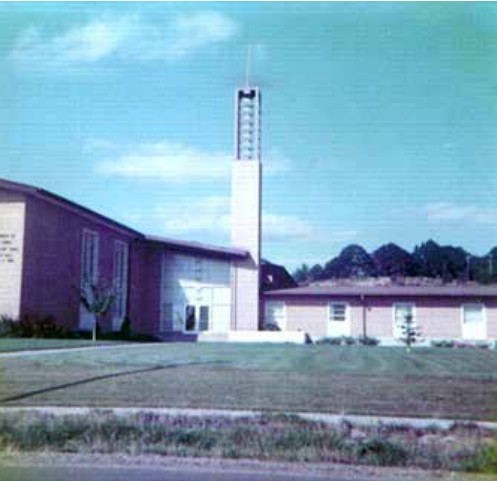
The sacrifice was celebrated as expressed in this poem from the Corvallis Stake history:
By Sister Carol Lantz
Their Story
Their story is set in concrete.
It is inscribed on drywalls and plywood sheathings.
It is a true story of Latter-day Saints who toiled side-by-side
with shovels and hammers, and just plain grit—
a family of Saints knit together in purpose
who willingly labored and opened their purses
to wrest from the earth a place of worship.
The edifice stands sturdy as ever, still pleasing to the eye,
made more so by a steeple that soars as an
epilogue to their tale of hard work.
Wards continue to be divided,
boundaries continue to be rearranged,
but a monument built with sweat and sacrifice
remains as it was when their story ended—
a story of ordinary people doing ordinary things
to achieve an extraordinary goal:
a building that touches heaven and earth
to meet the needs of its people.
My parents did not have much money and as the oldest of ten siblings I grew up watching them carefully conserve to make ends meet. My father was a blue collar worker with an average income at best while my mother worked full time taking care of the ten of us. They worked hard, sacrificed to be with us, teach us, and tried to be a good example. Church attendance, family home evening time, and church callings were priorities.
Once that I remember, probably between jobs, my family received church food assistance from the Bishops storehouse. The windows of heaven were open to us in many ways. I was old enough to see it, financially and spiritually. One of the biggest blessings that endures with my siblings is one of family unity. For over 45 years we have gotten together for a reunion at least once a year and have been a support to each other.
I have never viewed paying tithing or living church standards of conduct as a burden. It saves paying for the burden of vices which are expensive and painful. It allows one to pray for help and direction with confidence. As a youth I could see that other families not following God had far bigger problems than we did. I saw that the Bishop and Stake President and ordinary members put in hours of labor as an extra donation to the Lords Kingdom. I do not use the word Kingdom lightly. That is what we are building. It has never been all about me but always about family and a foundation for the future and most definitely physical as well as spiritual.
I have to wonder at the ignorance of those that criticize, thinking for example that the extremely poor in foreign countries should not be asked to pay a tithe. The critics just don’t get it. They seem to think of the poor as a lower class, separate and not really equal to those who have more money. But no, they have dignity too and are equal to every other member of the church. They have skin in the game. They will “inherit the earth”.
Because of the tremendous faithfulness of the members, the church has prospered more and more financially over the years. Slowly but surely more of the costs of running the church have been payed out of general Church funds rather than locally. After 1982 that included 100% of all building, maintenance and temple construction costs. This means of course that a congregation in a poorer country now receives the same infrastructure and necessary resources as more wealthy countries. The Church can afford to treat all with equity and equal value. I love that.
When I was a young proselyting missionary (1975-77) we were opening new areas in Quebec Canada that had never seen a missionary before. The prevalent religion was Roman Catholic which had far more members, money and resources than the tiny little Church of Jesus Christ of Latter-day Saints. My missionary companion and I baptized the first member of Alma, Quebec, Canada in the Lac Saint Jean and there is an LDS Chapel in Alma. Do I feel a sense of satisfaction about that? Absolutely. I rejoice in it.

And now we can fast forward to 2026. The Church continues to grow and prosper and is in fantastic financial shape. The following chart shows how the Church, as of 2021, has cash and investments that outstrip the largest companies and college endowment investment funds – except for Berkshire Hathaway.

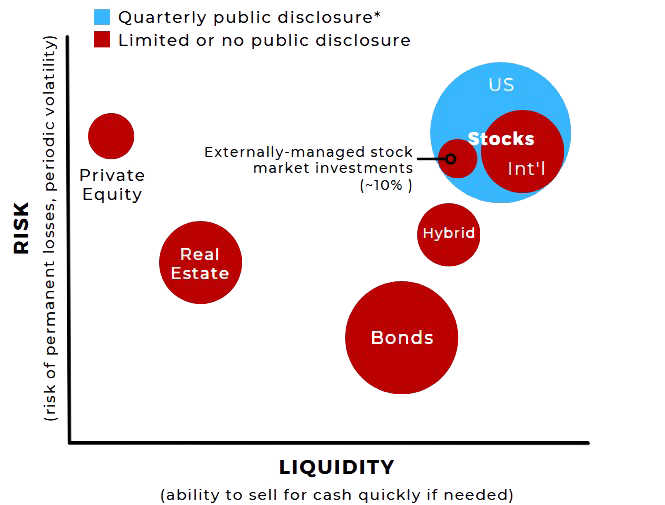
The chart below shows how those investment funds are distributed. The majority is in stocks and bonds with a high level of liquidity.
This graphic shows income revenue on the left and expenses on the right. Tithing and other donations fund the operations of the Church whereas investment income is plowed back into investments. This is the basic pattern.

Here is an historical view on how income has been spent. Note that this chart is in terms of percentage. This means that as the cost of Church operations increases in real time, the percentage of income assigned to Church operations is decreasing because the pie is bigger. The same is true for Member Welfare and Church Education expenses.

Courtesy of Grok xAI, this report shows the top six Christian denominations in the US. The Church carries no long term debt but has only logistical short term liability which gets paid off quickly. Note that most denominations have liabilities that meet or exceed liquid assets. They are living paycheck to paycheck.

Since only tithing and other donation funds are used for Church operations (about ~$9B annually), why does the Church maintain an investment portfolio approaching $200B?
I can mention two important reasons: 1) We live in the last days and the scriptures say “all things shall be in commotion” (DC 88:88-91); and 2) We are approaching the day when the full Law of Consecration will be implemented. In both cases, having significant assets in reserve will be needed.
And then there is the fact that Jesus commanded the wise use of His money. The scripture is worth quoting in full.
Matthew 25:14-30 (see also Luke 19:12-27)
14 For the kingdom of heaven is as a man travelling into a far country, who called his own servants, and delivered unto them his goods.
15 And unto one he gave five talents, to another two, and to another one; to every man according to his several ability; and straightway took his journey.
16 Then he that had received the five talents went and traded with the same, and made them other five talents.
17 And likewise he that had received two, he also gained other two.
18 But he that had received one went and digged in the earth, and hid his lord’s money.
19 After a long time the lord of those servants cometh, and reckoneth with them.
20 And so he that had received five talents came and brought other five talents, saying, Lord, thou deliveredst unto me five talents: behold, I have gained beside them five talents more.
21 His lord said unto him, Well done, thou good and faithful servant: thou hast been faithful over a few things, I will make thee ruler over many things: enter thou into the joy of thy lord.
22 He also that had received two talents came and said, Lord, thou deliveredst unto me two talents: behold, I have gained two other talents beside them.
23 His lord said unto him, Well done, good and faithful servant; thou hast been faithful over a few things, I will make thee ruler over many things: enter thou into the joy of thy lord.
24 Then he which had received the one talent came and said, Lord, I knew thee that thou art an hard man, reaping where thou hast not sown, and gathering where thou hast not strawed:
25 And I was afraid, and went and hid thy talent in the earth: lo, there thou hast that is thine.
26 His lord answered and said unto him, Thou wicked and slothful servant, thou knewest that I reap where I sowed not, and gather where I have not strawed:
27 Thou oughtest therefore to have put my money to the exchangers, and then at my coming I should have received mine own with usury.
28 Take therefore the talent from him, and give it unto him which hath ten talents.
29 For unto every one that hath shall be given, and he shall have abundance: but from him that hath not shall be taken away even that which he hath.
30 And cast ye the unprofitable servant into outer darkness: there shall be weeping and gnashing of teeth.
And so here is the main point: It’s our Lords money and he expects His servants to be wise stewards of it until He returns. No other justification is needed.